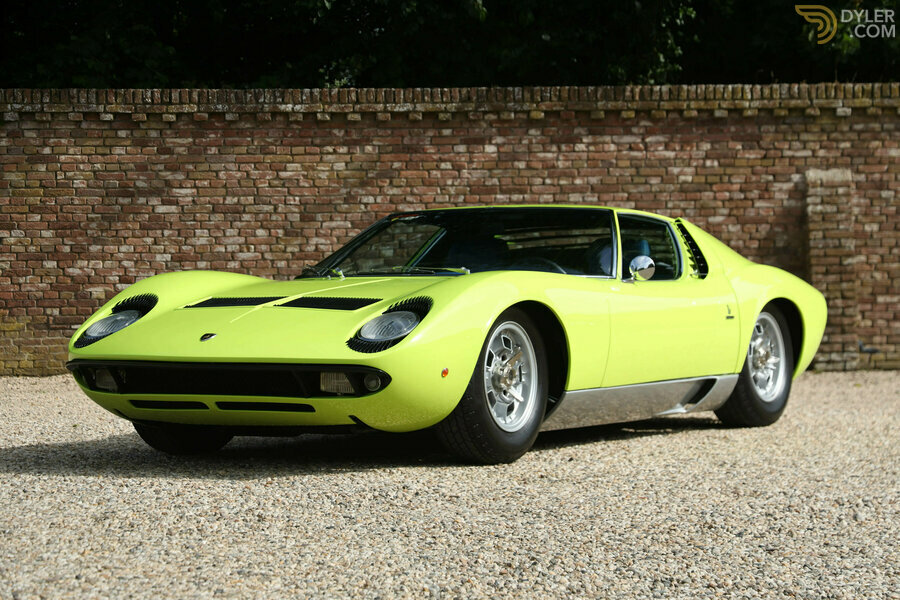
Some cars need no introduction. Ferrari. Porsche. Mercedes-Benz. And then there’s the Miura. Ask any enthusiast about the Lamborghini that changed everything, and this will likely be the first name that comes up. That’s remarkable for a car produced for less than eight years.
In the mid-1960s, Lamborghini was still a relatively young manufacturer. Ferruccio Lamborghini built beautiful grand tourers, but a true sensation was missing until a small team of engineers came up with an unusual idea: placing a twelve-cylinder engine transversely behind the seats, not in front of the driver but behind him. This concept evolved into the Miura.
When the Miura was unveiled, it was immediately clear that this was no ordinary sports car. The body, designed by Marcello Gandini at Bertone, was low, wide, and strikingly sleek. Even when stationary, the Miura radiated speed. Its famous headlights, with characteristic “eyelashes,” are unforgettable.
Technically, the Miura was exceptional. The transversely mounted V12 engine, positioned directly behind the cockpit, gave the car a unique character. The sound of twelve cylinders just centimeters behind your shoulders is hard to describe. In 1968, the Miura P400 S was introduced. Not much changed at first glance, but Lamborghini refined the concept with subtle interior adjustments, added comfort, and a slightly more powerful engine. It remained unmistakably a Miura but was further developed in several areas. A total of 338 P400 S models were built.
This particular car was completed in early 1969 as one of the early P400 S models. Its first owner was Italian film critic and director Renzo Renzi. The car eventually made its way to the United States, where it was part of a collection for many years. At the beginning of this century, it was fully restored by Bobileff Motorcar Company, a name well known among Lamborghini enthusiasts. After restoration, the Miura participated in various events and received several awards.
The condition of this Lamborghini is excellent, both cosmetically and mechanically. It has been consistently maintained, with Weber carburetors overhauled, mechanical parts replaced, and recent maintenance performed by a Lamborghini specialist in early 2026. The Miura still features its matching-numbers V12 engine, as confirmed by registration records and documentation. Manuals and model registries are included.
Ultimately, a Miura is about more than its impressive design and head-turning presence. More than half a century later, it still does what it did when new: it makes people stop in their tracks. Very few cars can do that.
If you are interested in this incredible Miura, contact Gallery Aaldering to discover this Lamborghini for yourself. We export our vehicles worldwide—ask about the possibilities.