Only a select number of postwar automobiles have achieved the unusual status enjoyed by Glenn Pray's Auburns. Rather than simply reproducing a classic automobile, Pray set out to revive the spirit of the Auburn Motorcar Company by combining its unmistakable styling with modern American mechanicals, creating what he regarded as a continuation of the marque. Today, these cars occupy a unique position among Auburn, Cord, and Duesenberg enthusiasts, appreciated not merely as replicas, but as carefully constructed "Second Generation" Auburns that carry the name, design language, and mechanical philosophy of the originals into the modern era. Glenn Pray's cars are accepted and celebrated within the Auburn-Cord-Duesenberg community, where their quality, rarity, and connection to the marque's history have earned them a devoted following.
The story began in 1960, when Oklahoma schoolteacher and longtime Auburn and Cord enthusiast Glenn Pray acquired the Auburn-Cord-Duesenberg Company from Dallas Winslow, who had preserved the company's remaining parts, tooling, and inventory following the original Auburn Automobile Company's demise. Pray moved the operation to Broken Arrow, Oklahoma, where he established himself as a leading authority on the orphaned marques and supplied parts and expertise to owners and restorers. His ambitions soon extended beyond preservation. After reviving the Cord with the 8/10 in the early 1960s, Pray developed a modern continuation of the Auburn Boattail Speedster, with production beginning in the late 1960s.
The 874 Dual Cowl Phaeton represented perhaps the most ambitious expression of Pray's vision. Based upon the elegant 1937 Auburn 874, the new Phaeton retained the dramatic dual-cowl styling while utilizing a shortened modern chassis and Ford V8 powertrain. Contemporary accounts emphasized that the car was not intended as a literal replica, but as a newly built automobile using the original Auburn's design and trappings while incorporating modern technology. The cars were assembled by hand at Pray's Broken Arrow facility, with the 460-cubic-inch Ford V8 becoming a defining part of the formula.
Production of the 874 was exceptionally limited. Auburn-Cord-Duesenberg records and marque references indicate that only 17 total examples were produced, consisting of one prototype and 16 production cars. The 874 was among the final automobiles built by Glenn Pray, making each production example an exceptionally scarce member of the Auburn family.
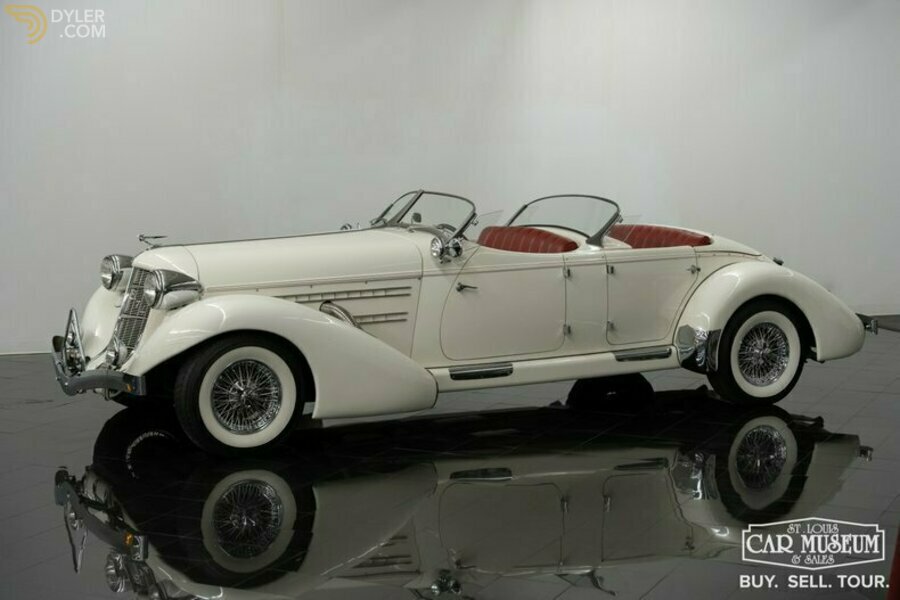
This 1979 Auburn 874 Dual Cowl Phaeton represents the fifth production example. It is presented in a striking Classic White over Lipstick Red color combination, accented by a black cloth convertible top with contrasting red piping. Its long, low profile, sweeping fenders, dual windshields, prominent grille, and dramatic rear bodywork create the unmistakable presence that made the original Auburns legendary, while giving this Second Generation example an identity all its own.
Power is supplied by a Ford 460-cubic-inch V8, backed by a Ford C6 automatic transmission and a 9-inch rear axle. The modern Ford drivetrain provides effortless torque and dependable road manners, central to Glenn Pray's philosophy of updating classic Auburn styling with contemporary mechanical components. Power steering and power front disc brakes further enhance drivability, while 15-inch chrome wire-spoke wheels are fitted with Coker Classic 225/75R15 wide whitewall radial tires.
The equipment list is impressive and period-correct. Features include Stewart Warner instrumentation, a tilt steering column with a sports steering wheel, dual Unity spotlight mirrors, fog lamps, a grille guard, and seatbelts.