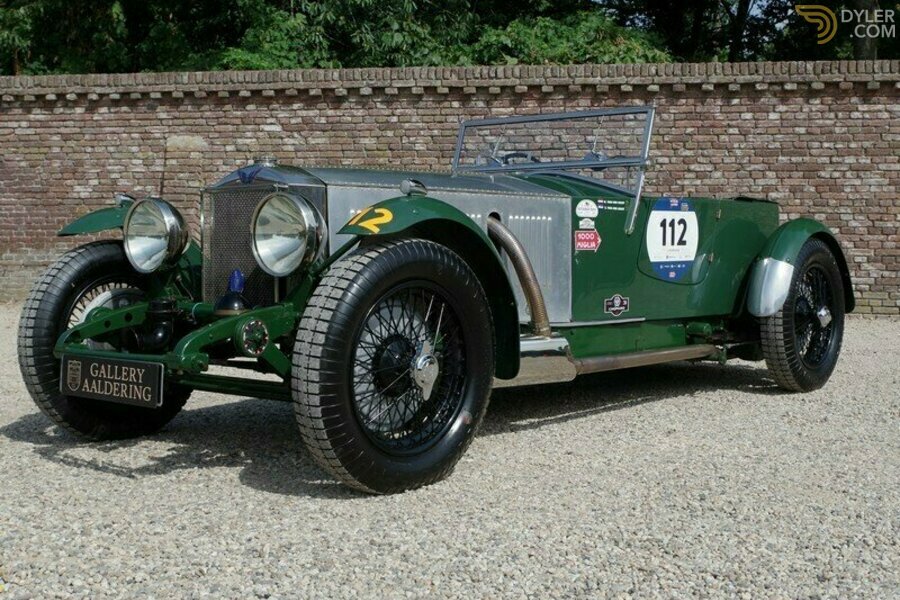
The story behind this Invicta is a very special one and deserves to be told in full. In July 1999, the first owner in England was tipped off about a 1932 Invicta 1 1/2 chassis. The chassis had been saved from the scrapyard in the 1960s, and after lengthy negotiations, it was taken to the workshop of Invicta specialist Rob Pollock. The current condition was assessed, and a plan was drawn up to give the Invicta a new lease of life.
The project began in 1999. The foundation was far from perfect. The car had once had a saloon body, but little remained of it. It came with a 4 1/2-liter engine. The man who had saved the car from the scrapyard had thought about—or perhaps dreamed of—building an Invicta 4 1/2 Special someday. It was quickly decided that the 4 1/2 Special was the way to approach the project. The 1 1/2 chassis has the same dimensions as the 4 1/2 chassis. The wheelbase and track width are even identical. The ideal basis, therefore, for a reproduction of an Invicta S-Type.
Rob Pollock was asked to estimate the time it would take to turn the bare chassis into a complete S-Type recreation. His conservative estimate was a couple of years. In practice, the entire project took at least five times as long. The complete dismantling of the base didn’t take long, and meanwhile, another specialist was tasked with fabricating a body in the style of the ones Carbodies made for Invicta at the time of the S1.
The first owner wanted to be involved in the process, so he was responsible for finding several missing parts. These included five Rudge-Whiteworth 19-inch wheels, Rotax 10-inch headlights, all instruments, two SU-HV5 carburetors, a steering wheel, a Marles L3 steering box, a transmission, period-correct Bosch horns, a hood latch, shock absorbers (Luvax and André Hartford), a starter motor, an alternator, an ignition system, water and fuel pumps, fenders, seats, an oil pan, a valve cover, a cooling fan, and numerous small parts.
The transmission posed particular challenges. Initially, a full synchromesh transmission from an Alvis was chosen; when that didn’t fit properly, a Rolls-Royce 20/25 transmission was selected. Thanks to a conversion adapter, the transmission was connected to the engine, and a Borg & Beck clutch was used.
The fenders were originally intended for an Alvis but were adapted for the S-Type body by specialist Simon Parker, who also fabricated the hood. The seats, sourced from the United States, are original Invicta S-Type seats. To ensure a solid foundation, the chassis was boxed in and reinforced with S-Type cross members, and an Invicta A-Type bulkhead was custom-fitted.
A new, improved S-Type replica radiator with better cooling and flow was installed. New, stronger drive shafts, larger wheel nuts, and a fabricated Invicta S-Type fuel tank were added. The engine was rebuilt from scratch using many new parts. The car received a new wiring harness and a completely new exhaust system. It was painted in its current color scheme, a new interior was crafted, and the front suspension was replaced.
The Marles L3 steering box was fully overhauled before installation. On August 18, 2010, the Invicta passed its MOT, the British equivalent of the APK. The project took 11 years to complete, not a few as initially estimated. The car was then put into service and used regularly.
During the first drives, suspension settings were further adjusted, and Luvax shock absorbers were installed. The car was used regularly for several years before arriving in the Netherlands in 2017. In 2017, the previous owner had the car completely overhauled once again by a specialist.